Monday, 26 September 2016

The importance of a strong ankle | American Football

 
Photography: Micheal Oakes

The ankle joint - The area I spend so long taping each week. Why? Because (1.) This is the most common site of injury I see. (2.) People don’t do their rehabilitation following injury (despite my constant reminders). (3.) People don’t protect this joint in the first place.

Within American Football, the ankle is put under enormous strain by large loads placed through it in jumping, acceleration, driving, landing and cutting manoeuvres. Unlike a sport such as sprinting where the athlete runs in one straight line, the majority of AF players are required to change direction at speed. In addition, at grass roots level, we aren’t always so lucky to play on an even grass pitch. Instead, we visit grass pitches with plenty of pot holes, frozen ground or pitches which are water-logged. This presents a more challenging picture for the body, and the foot and ankle are its first contact. Therefore it is important that the ankle is able to adjust to its surroundings. In conditioning terms we call this proprioception. This is essentially training balance on different surfaces so the ankle is strong enough to correct its positioning if forced or placed into a position which could put it at risk of injury (such as turned inwards or outwards). Single leg exercises are therefore incredibly important. We may run on two legs, however we only have one foot in contact with the floor at any one time. Thus it is important to train using single leg exercises to crossover to this and also correct any asymmetries. These can be combined with change of direction drills. Of course it is vitally important that the individual can safely and properly move on both legs prior to single leg work. This reduces the risk of injury when training.

Unlike what you might think, rehabilitation and preventative exercises are actually the same. It is where you start your programme that is different. For the athlete recovering from injury their exercises will be very simple and these will slowly be progressed to something more challenging. However, as previously stated, this doesn’t mean all non-injured athletes can start performing single leg bounds. This is an advanced exercise and must be performed properly or risk injury.
Taping and bracing can help reduce the risk of injury, but the cost for the individual or team can be huge by the end of season. For many, I believe tape often acts as a placebo. Personally I would much rather have the confidence in my ankles by having strengthened them properly than rely on tape. Over the past season I have also used Kinesio Tape, in conjunction with other treatment, to bring down swelling and bruising at the ankle with positive results. I do support the use of athletic taping in the correct useage i.e. if it gives the returning player added confidence, however those players using it in place of rehabilitation I do not.

Of course there are some injuries which cannot be prevented such as contact injuries.

On a final note, I believe that it is the coaches and players responsibility to assume responsibility for preventing injury risk i.e. not forgetting the ankle joint! Players should also follow a comprehensive rehabilitation programme prior to returning to play to ensure they do not put themselves at risk of injury once again.


Interested in learning what ankle strengthening exercises to perform? Keep an eye out for further blog posts!

-E
SHARE:

Friday, 3 June 2016

Five Summer Fitness Tips for the Dancer


A big part of dancing is long days of training or performing. Feeling strong and fit can really help you to perform your best within class and onstage, preventing fatigue and ultimately preventing the risk of injury. If you put the effort in, you can reap the rewards and see your full potential through maximised performance. Whilst it is great to take time away from dance over the summer in order to rest and recover, it can also be a period of reversing all your hard work over the previous year. Returning to class you may feel that your once strong muscles are now sore and tired. Take a read of my five top tips for unleashing your skills this summer, so you can come back stronger the following season...


Aerobic training

Choose an aerobic exercise you most enjoy. For me this would be swimming or cycling, but others could try running or rowing. These cardiovascular exercise are perfect for increasing your fitness levels so that you are less fatigued by the end of dance class.


Get outside

Just because you spend the rest of your year inside a cold, dark studio doesn’t mean you should train in the same conditions, in fact quite the opposite. Get outside to catch those rays, perfect for boosting your Vitamin D levels which have been proven to improve muscular strength, increase jump height performance and reduce injury levels. So instead of doing a pilates session indoors, take your mat into your back garden, or go for a bike ride with friends. But don’t forget your sunscreen!


Incorporate dance specific exercises

Identify the muscle groups involved within specific movements and train them. For example, a port de bra can be mimicked using therabands to strengthen shoulder girdle, or bosu ball can be used to train balance and strength in the lower legs.  


Work on your weaknesses

Perhaps you picked up an injury this past season and now you feel weaker than previously in that area. Well now is the perfect time to revise that situation and to come back stronger than you were before.


Try something new

Now is the opportunity to try a new activity. Perhaps you’ve always wanted to go surfing, or fancy going for that long walk along the coast. DO IT! Get out and let your mind and body relax so that you can return to dance feeling fresh and enthused.


Enjoy!
 -E
SHARE:

Thursday, 12 May 2016

My Past Dance Injuries


In a past post I mentioned I had suffered from a dance related injury. This injury was greatly overlooked and could have been prevented had I taken supplementary classes. I suffered from Chondromalacia Patella. This is roughening of the articulate cartilage on the underside of the patella. This cartilage can become soft and wear away, causing anterior knee pain. Luckily I was not at this stage and was able to rehabilitate. Chondromalacia Patella is caused by the incorrect tracking of the patella due to a muscle imbalance within the quadriceps. Through my dance training I had become dominant in my vastus lateralis which pulled my patella laterally out of its groove, causing pain with active movement. Through simple Pilates and strength training exercises, by the guidance of my Sports Therapist I was able to strengthen my Vastus Medialis and glutes to correct the problem.
Source - Google


Here are a few of the exercises I used to perform -


Single Leg Bridge

1.       Lie on your back with your knees bent to 90 degrees with your feet on the floor. Arms palm up at your side.

2.       Draw in your abdominal muscles, maintaining this throughout the exercise.

3.       Squeeze your glutes together and slowly raise your bum off the floor until your torso is in line with your thighs. Lift off one leg so that it is in-line with the other thigh. Ensure the hips stay level.

4.       Hold for 10 seconds and lower.

5.       Repeat 10 times on each leg.


Glute band walk

1.       Place the band above the knees.

2.       Keeping the glutes squeezed and the knees pushed out, walk side to side (crab walks) and forwards and backwards (monster walks).

3.       Ensure walks are slow and controlled.


Swiss ball squats

1.       Stand with your back facing the wall. Place a swiss ball at the lower back between you and the wall. Place feet slightly in front of the body.

2.       Hold a light medicine ball between your knees.

3.       Lower yourself until your legs are at 90degrees.

4.       Hold for 10 seconds and squeeze the ball.

5.       Drive up out of the squat to the starting position.

6.       Repeat 3 sets of 12 reps.


Please remember everyone’s injuries are different, therefore each may require different treatment. What worked for me may not work for you. However, these exercises are good, simple strengthening exercises which can be incorporated into your supplementary training regime to help prevent muscle imbalances.
If you have any questions, don’t hesitate to get in touch!
-E

SHARE:

Wednesday, 9 March 2016

Overtraining and the Dancer


What is overtraining?

Overtraining is a condition where active individuals may complain of: reduced physical performance for no apparent medical reason, suffer constant fatigue and show emotional and behavioural changes.
The term overtraining can be used interchangeably with the term burnout.
Overtraining can occur when the pressure of training becomes too high and the body is not allowed to recover. Mirco-damage to the bodies muscles, created through training, requires sufficient time to repair in order to prevent further damage. When this happens and the body is allowed to recover, adaption occurs. Positive adaptations means an increase in performance through increase power, strength and endurance.
There are two types of burnout, acute and chronic.
  • Acute burnout may last for less than one month, for example, it may begin at the beginning of a new season for the dancer. This acute burnout may result in muscle damage causing pain and stiffness, but can quickly disappear.
  • Chronic burnout may accumulate over a period of weeks or months. Possible signs and symptoms may include menstrual irregularities and a lowered immune system causing more frequent illness, in addition to other signs and symptoms.

Contributing/risk factors

There are many factors which can contribute to burnout, such as:
·         Difficulties within personal and family relationships
·         School and work difficulties
·         Financial difficulties
·         Highly motivated individuals – highly motivated induvial will often push themselves further to achieve their ultimate goal. This can be positive, however when the individual is pushing and overexerting themselves, this may lead to injury and illness.
·         Individuals with lower fitness levels – not everyone holds the same levels of fitness, and within a dance class it may sometimes be difficult for those with lower levels of fitness to keep up with the rest of the class working at a high pace or during a longer class. These individuals should be aware of their limits and allow themselves time to recover, which in turn will develop their fitness levels instead of experiencing overtraining symptoms.
·         An increase in physical activity such as when preparing for a performance - when there is sufficient time for the body to adapt, the body will cope with an increase in rehearsal time or demanding choreography. However when this period of time is not allowed, the body will struggle.
·         Young professionals within the first year with a company - these dancers may be less willing to, or unable to say no when asked to increase their periods of rehearsal. In addition, there will be increased roles to learn, therefore more studio time in class.
·         Dancers are at great risk from overtraining due to the fact that they are conditioned to cope with a heavy workload without complaining. Dancers have a high level of self-discipline, in addition to the awareness that another dancer could easily take their role if they are not up to standard.

What are the signs and symptoms?

·         A decrease in physical performance – both a loss of stamina and technique
·         Constant fatigue
·         Negative moods
·         Frequent injuries
·         Disturbed sleep patterns through possible stressful dreams and night sweats
·         Unrested body and an unfocused mind
·         A decrease in sense of humour
·         A change in mood, such as dramatic outbursts
·         A loss of appetite
·         Elevated blood pressure and heart rate
·         Excessive sweating
·         Overuse injuries
·         The inability to recover fully after intensive dancing

How can you deal with burnout?

There are numerous ways to manage burnout/overtraining such as:
·         Counselling
·         Sleep
·         Massage – to help the body and brain to relax
·         Supportive environments – through dance teachers, family and friends
·         Rest periods away from physical activity.
                         

Can it be prevented and treated?

Correct programming through planning periods of rest and exercise are crucial to prevent overtraining. Recovery periods may be scheduled between classes or on particular days for the individual’s personal schedule. For the dance school/company, it is also important to include rest days whilst on tour. Additionally, choreographers should be careful of making best use of their time with dancers in order to prevent overexertion.
Additional ways to prevent overtraining are;
·         Including supplementary training within an exercise programme which may act as a stress release – for each individual this will be different
·         Ensure good hydration and nutrition to provide adequate fuelling for exercising
·         Ensure ‘down time’ within the programme to build a period of relaxation.
·         Ignore the notion of ‘no pain, no gain’. Working through fatigue, illness or injury has no positive impact on performance but can cause further damage.
·         Teachers should be aware of the signs and symptoms of overtraining and, if a dancer suffers from overtraining they should be careful to look after the mental status of their dancer, providing support, advice and guidelines.

If you are a dancer based in the North East of the UK and are experiencing symptoms of overtraining, or are looking to prevent it, I am happy to assist by creating a home supplementary programme for you, or by providing massage therapy. Contact me via email at performancesportstherapy@hotmail.com .
-          E


References :

  • Rist, R. and Koutedakis, Y. (2006). Dealing with Burnout. Available: http://www.dance-teacher.com/2006/03/dealing-with-burnout/. Last accessed 4th March 2016.
  • Koutedakis, Y., 2000. Burnout in dance. the physiological Viewpoint Journal of dance medicine & science, 4, pp.122-127.
  • Quested, E. and Duda, J.L., 2011. Antecedents of burnout among elite dancers: A longitudinal test of basic needs theory. Psychology of sport and exercise, 12(2), pp.159-167.
SHARE:

Thursday, 11 February 2016

Aerobic training for the Dancer

Source: Pinterest
Dance is not often regarded as a sport, however the demands are just as high as those of Olympic athletes. Dancers require the same psychological readiness, motor control and aerobic and anaerobic capacities of their fellow sports men and women, yet they require something more complex.  A level of personal artistry is required by the individual during performances with an aim to achieve an aesthetic goal of clean lines, high elevation, precision, poise and grace whilst maintaining the endurance to perform anaerobically on and off for 30-60seconds at a time. Additionally, a level of strength is required to hold limbs against gravity and speed to move efficiently in a coordinated and effortless rhythmic manner. Thus dancers must be physically ‘fit’. However, only 40% of a dancers fitness may be linked to their genetics, leaving a large 60% to the dancers regular training, diet and appropriate lifestyle.

Researchers have found dancers less physically well-conditioned than sporting athletes through lower anaerobic values as well as lower maximal oxygen uptake compared to elite adolescent endurance athletes.

A dance class of centre work reaches 70-80% of VO2 max, with similar responses during ballet performances. A class, however only reaches this intensity for a brief period of up to 3 minutes, 16-32 jumps or a 15-20 second grand allegro combination. Because fairly strenuous exercise intensities for at least 20 minutes are needed to bring about an increase in aerobic fitness, it is unlikely that a class provides a suitable stimulus for adaptation.


Improving aerobic endurance

Aerobic endurance is the body's ability to supply the muscles with the oxygen they need to continue working over an extended period.

   This is affected by the lungs efficiency to take oxygen into the blood, how well the heart and arteries can pump the oxygen rich blood to the muscles, and how efficiently the capillaries can release the oxygen, then complete the cycle by exchanging carbon dioxide for fresh oxygen.

    When challenged by working a little longer or under more intensity than normal, the aerobic capacity expands.


How to improve aerobic capacity

It is recommended to engage in activity that increases your heart rate (HR) to 75% max HR for 20-30 minutes 3 or more times a week.

You can find your maximum HR through this formula:
220 – (your age) = estimated HR max in beats per minute (BPM)
This formula may find your aerobic training target:
HR max X .75 = Aerobic training target

Personal Heart rate monitors are not ideal to wear when dancing, especially when performing, due to a wrist watch monitor, however one may be worn whilst doing additional training to record exercise effort.

There are many enjoyable aerobic activities to partake on your own or in a group/club such as; jogging, running, swimming, cycling, cross training, rowing etc. Many of these activities can be done both indoors and outdoors, thus there is always a way to keep things interesting and easy to work around dance class.


Please comment with any questions or contact me if you want a personalised training plan
- E


SHARE:

Wednesday, 13 January 2016

The Stretch Shortening Cycle


In a previous post ‘Jump Height and the Dancer’ (http://performance-sports-therapy.blogspot.co.uk/2015/10/jump-height-and-dancer.html) I wrote about the use of plyometric training to enhance performance, prevent injury and rehabilitate athletes. Following on from this post, I am going to give you a little background information into the physiology behind it all.

I’m not one for writing massively long posts, and I know dancers aren’t one for reading them either. So here is a quick read on the stretch shortening cycle, what it is, and how it works.


source: Pinterest


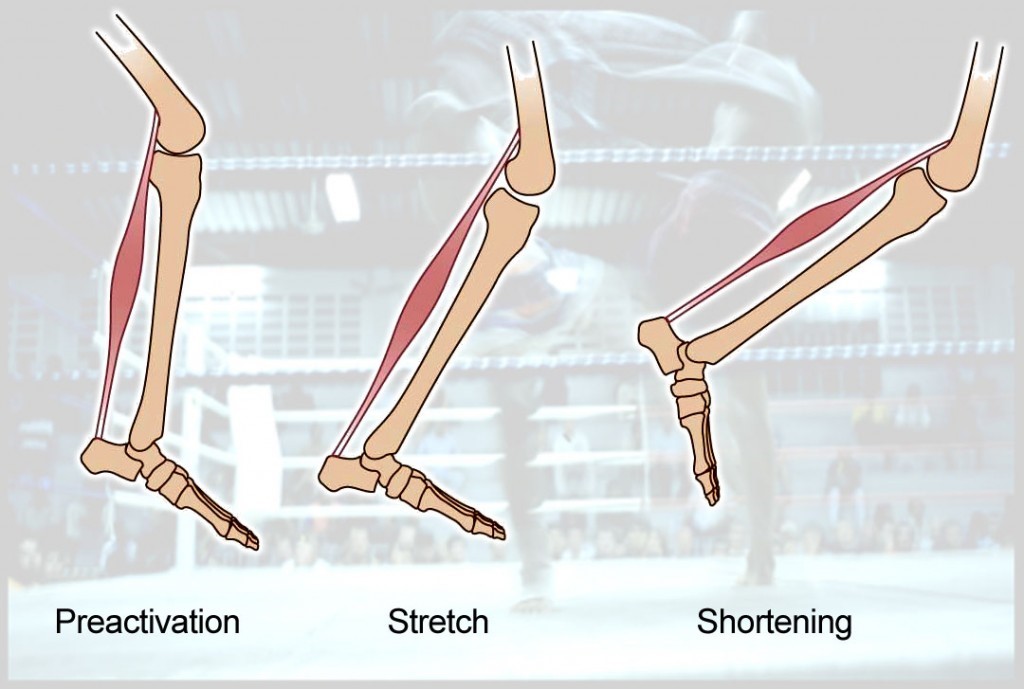
The Stretch Shortening Cycle (SSC) is the body’s natural way to stretch, and so store energy. The benefit of this cycle comes by using it, in addition to your body’s own muscular strength. So, the more muscle, the bigger the stretch and the more elastic energy that can be stored.

Let’s take a look at how this works…

source: Google Images


The stretch shortening cycle involves two phases of muscular contraction

1.Eccentric phase – muscle lengthening under tension
2.Concentric phase – muscle shortening

The pre-stretch of the muscle causes it to be eccentrically lengthened. With this, tension is built in the muscle – similar to a rubber band when stretched. The longer the time the pre-stretch is held, the less tension is stored in the muscle. The shorter period of time for the pre-stretch, the larger the amount of tension.

This stored energy helps increase the strength of the following contraction.

The faster the muscle is stretched eccentrically, the greater the force will be on the following concentric contraction. For example, a quick plié into a Pas de Chat creates the tension necessary to create height off the floor.

Have a go yourself –

1. Take a rubber band or hairband and hold the band stretched for 5 seconds then release. Notice the small distance the band has travelled. Now, in one movement take the second band, pull back and release. You will note that this band travels a lot further. This is because the second band has not lost tension in the period it is held in, therefore it has a larger amount of tension.
2. The same principle applies when looking at a squat jump (SJ) in comparison to a countermovement jump (CMJ). Sit in a Squat jump and hold this squat position for 5 seconds. After 5 seconds, release and jump.

Next, perform a quick countermovement jump. You will notice
that when you performed a CMJ your jump height was greater.


I hope this brief article helps you to understand how the stretch shortening cycle works and how this can be applied to plyometric training which I shall look at in more detail in a future post.


-E
SHARE:

Friday, 8 January 2016

Squats and the Dancer


What is a squat?

A squat is a major lift. One which should be performed within any strength and power training programmes. This movement is a compound exercise. This means that the lift encompasses all the joints and coordinated actions of several muscle groups.

There are 3 main variations of a squat. These are – the front squat, the back squat and the overhead squat. For the dancer each movement is beneficial to achieve full conditioning at every neuromuscular and joint complexes.


Here is an example of a back squat.

Why Squat?

There are numerous reasons to squat as a dancer. Here are the reasons why you should start today-
Strength gain – strength, the ability of muscle to exert a force against a given load. When you are carrying the weight of the bar overhead, on the back or the front your muscles generate a force against gravity to control the bar down and then back up. By increasing the weight of your squat over a period of time you increase the strength of your muscles.

Burn fat – moving requires energy, muscles burn this energy to control and lift when squatting. Squats use more energy than other major lifts because they work more muscles, with heavier weights. By increasing the weights of your squats, your metabolism will be boosted. This is because, an increase in muscle needs energy, therefore a burning of fat and you gain a larger appetite.

Strengthen bones – the compression of the weight under the bar adapts your bones to become denser. For the female dancer this is particularly beneficial as it reduces the risk of osteoporosis and so reduces injury.
Strengthen joints – squatting strengthens the muscles surrounding the joints, creating support for these and so helping prevent injury. However, it is key to perform proper squat form in order to strengthen your joints rather than stressing them.

Increase balance – your proprioception and coordination is improved through correct squatting (free weights). This allows you to increase learning of new motor skills within sport and everyday life. For example, when learning a new dance routine, you will be better conditioned to pick up the routine with correct muscle recruitment, as well as holding an arabesque for longer.

Increase explosiveness – a squat increases explosiveness for sport through increasing muscular power. This prevents you becoming slow in movements and make them faster. The more work you can do in a given time, the greater the power you have.

Build endurance – through building strength in your legs you increase the period of time you can work. For instance, if you are performing multiple allegro within a performance, you will jump higher and longer with less effort. It also allows you to work for longer periods of concentrated work.

Increase fitness – when you squat you stress one particular muscle…the heart. As you strengthen the muscles in the legs, trunk, back etc, you also strengthen your heart. By doing this, exercise puts less and less strain on your heart, your heart rate decreases, you don’t become as out of breath and your blood pressure lowers. This increases your cardiovascular fitness.

Build muscle – as a compound exercise you are working a lot of muscles to balance and move. The more weight you have piled on, the larger the muscles become.


How do you perform a back squat?

Place the bar in the squat rack at a level slightly below shoulder height.

Settle the bar across the base of your neck with the bar resting on top of the trapezius and deltoids. Ensure you are positioned in the centre of the bar prior to movement.

Hold the bar in an overhand grip, with hands evenly spaced and elbows bent at 90 degrees.

From this position take the weight of the bar, stand straight and take a few steps back.

Fix your eyes on a point in front of you, slightly above eye level and keep your eyes fixed here throughout the lift.

Pull the shoulder blades back (Imagine holding a pen between the shoulder blades). Push your chest up and out.

Feet should be flat on the floor and roughly shoulder width apart (although dependant on the individual). Toes may be pointed slightly outwards, however some may find it more comfortable facing forwards.

Before beginning the lift take a deep breath in. hold this until the final stage of the lift. By doing this you aid stability at the trunk by increasing intra-abdominal pressure.

You should tighten the glutes and lower back then begin the movement by flexing the hips and knees simultaneously. The trunk should be kept upright throughout the lift, with the back in a neutral position.

The knees should move in the same direction as the toes. Do not allow your knees to drop in towards each other. This is a weak position and so puts you at risk of injury.

Continue the downward movement until the thighs are past parallel with the floor i.e. the knees are past 90 degrees. Go as low as possible while maintaining the correct technique.

The ascent of the lift should be led by the chest, with the torso kept upright. Hips and knees are extended through a powerful drive from the legs.

At the top of the lift reaching a standing position exhale.


The starting position of the lift


Sitting back, as if onto a chair, while keeping a neutral spine. 
  

Continuing the downwards phase of a squat

The bottom position of a squat
  

Avoid squatting in a plié position to ensure correction of muscle imbalances


Do not allow your knees to fall into a Valgus position. If this occurs, lower the weight and concentrate on form. Strengthening the glutes will also prevent this from happening.


Why squat out of second position?

Proper squat form is key to prevent back and knee pain. For dancers, this means squatting with feet in a more parallel position. By this I mean not in full second position. But why you ask? This is so that those muscles which become weaker when dancing in second position may become stronger, thus the imbalance is corrected which will help prevent injury. Please note that this is the same when performing plyometric exercises such as squat jumps etc. 


I hope that this article is of use to those unsure how and why to squat! If you have any questions please comment below!

- E


SHARE:

Tuesday, 15 December 2015

Gym Etiquette

A few months ago I joined a new gym just outside of Newcastle. This gym, along with the usual gym stereotypes, includes one particular couple. This couple often train at the same time as me, so over the months I have been able to watch the efforts - no progress - of the pair. It is becoming a regular sight to see boyfriends training their other half when they have no clue about lifting themselves. The male of the pair in my gym clearly has a little lifting knowledge, however not on the side of correct form and biomechanics. And so, during a squat (performed by the girlfriend) the upwards phase has the poorest knee control I have ever seen. Her knees practically touch! As a sports therapist and S&C coach I wince each time I watch this happen. I am lucky to be aware of correct mechanics for lifts and so able to avoid injury myself. 

But what do I do as a professional? I feel it is my duty to prevent injury, whereas others I have spoken have had the opposite approach. These therapists have said they wouldn't intervene. Instead they would wait until the gym-goer visits them for treatment and recovery from injury. In my own professional opinion this is just not right as I do not wish harm on anyone, nor do I wish to take someones money if an injury can be prevented. Surely it is our duty of care to prevent such an injury?

However I am aware that it can be embarrassing for some to be approached in the gym and to then be corrected on technique or given general advice. Therefore it was an idea of mine to catch this girl in the changing room and voice my concern as a professional. I thought perhaps this might be less intimidating and a more friendly approach.

What do you think is this a suitable intervention as a therapist or S&C coach? I don't wish to cause embarrassment, only prevent injury.

What is your view on intervening in the gym? Do you have experience in this area as a professional? I would love to hear your stories and advice!     
- Ellieee x
SHARE:
© Performance Sports Therapy. All rights reserved.
Blogger Templates by pipdig