Thursday, 8 September 2016

All you need to know about muscle cramps


What?
Muscle cramp is the sudden and involuntary painful contraction of muscle (or part of it), which disappears within seconds or minutes and is often accompanied by knotting of the muscle during touch.
Cramp is the repetitive firing of motor unit action potentials, also known as “cramp discharge”.
The cause of cramping is unknown, however it is traditionally believed to be associated with exercise in hot and humid climates i.e. Dehydration and the depletion of electrolytes. However this isn’t fully backed by scientific evidence. Another theory suggests there is a neuromuscular cause. This thought proposes that the muscular overload and neuromuscular fatigue causes an imbalance between the excitatory impulses from muscle spindles and inhibitory impulses from Golgi Tendon organs. However, due to muscle cramping occurring within a variety of situations and environments conditions, some believe it is unlikely that there is a single cause.

Cramp vs. Spasm
It is possible to distinguish cramp from spasms. A spasm is an involuntary and abnormal muscle contraction, however cramps are severely painful (and can result in continued soreness), carry an involuntary and explosive onset with a gradual termination of the muscle stretching. This involves only one/one part of the muscle and it is possible to experience fair and forceful contractions. In addition, muscle cramps tend to occur within the muscles of the calf and foot which can in turn impair athletic performance.  

Who?
Cramps can occur in individuals with motor neuron disorders and metabolic disorders, but can also occur within healthy individuals during sleep, pregnancy and physical exertion.
Some of the reported risk factors for exercise-associated cramps include-
  • Inadequate conditioning for the activity
  • Increased exercise intensity and duration
  • Previous history of cramps during or after exercise
  • Family history of cramping.


Treatment
  • Moderate static stretching 
  • Prevention and treatment methods include fluid and electrolyte balance strategies. The National Athletic Trainers’ Association recommends that athletes prone to muscle cramps add 0.3 to 0.7g/L of salt to their drinks as a preventative tool. Others recommend adding sodium (3.0 to 6.0 g/L) to sports drinks based on the frequency of muscle cramps.Note: fluids and electrolytes are not immediately absorbed. Around 13 minutes is required to be absorbed into the circulatory system.


Prevention
  • Neuromuscular training – there is strong support that the level of conditioning is a factor for the development of muscular cramping and that targeting the neuromuscular system can prevent this. The idea is to prevent neuromuscular fatigue. This could be done through plyometric and endurance training.
  • Ingestion of water or a hypotonic sports drink an hour prior to competition ensures absorption.
  • Maintaining hydration and adequate electrolytes aid in the prevention. Thus, fluids should be readily available throughout practices and competitions.
  • A balanced diet is important to ensure fluid and electrolyte replacement.  


References
Minetto, M.A., Holobar, A., Botter, A. and Farina, D., 2013. Origin and development of muscle cramps. Exercise and sport sciences reviews, 41(1), pp.3-10.
Braulick, K.W., Miller, K.C., Albrecht, J.M., Tucker, J.M. and Deal, J.E., 2013. Significant and serious dehydration does not affect skeletal muscle cramp threshold frequency. British journal of sports medicine, 47(11), pp.710-714.
Miller, K. C., Stone, M. S., Huxel, K. C., & Edwards, J. E. (2010). Exercise-Associated Muscle Cramps: Causes, Treatment, and Prevention. Sports Health, 2(4), 279–283. http://doi.org/10.1177/1941738109357299

SHARE:

Friday, 20 May 2016

The importance of Vitamin D for the dancer


It’s pretty standard that a sunny day brings out a good mood in all. I just love opening the curtains wide and letting the sun’s rays flood the house and jump at the chance of visiting the beach in some shorts to catch some colour. Well it turns out that the sunshine isn’t just good for our moods, but also building a healthy body…

With limited hours being spent in natural sunlight due to many hours being spent inside from classes or rehearsal, dancers are at a greater risk of Vitamin D deficiency. A 2013 study by Wyon et al. found dancers to have insufficient levels of vitamin D, especially within the winter months.

Vitamin D is a vital nutrient for maintaining strong bones and helping the body to absorb calcium. Calcium is vital for growth, immune function, blood pressure, muscle mass and strength. So it is no coincidence that research has found vitamin D supplementation to be beneficial in increasing vertical jump height and isometric muscle strength, whilst also reducing injury rates within elite ballet dancers.

It is believed that due to the high levels of stress which is placed on dancer’s bones and muscles, a vitamin d deficiency can cause greater harm on their bodies, than others who train at a less intensive level. A stress fracture is a common injury within the dancing population, and although it may be caused by poor programming, technical or biomechanical factors, it could also be linked to a vitamin D deficiency.

Dr Wolman (National Institute of Dance Medicine and Science) recommends that dancers need about 1000 IU of vitamin D3 a day, however for the deficient dancer higher levels may be needed. If you are worried about your Vitamin D levels, contact your Dr who can perform a simple blood test to calculate your levels.

Vitamin D can be found in natural sources of food such as salmon, tuna, eggs, cheese and milk. You might, therefore wish to contact a registered dietician who can advise you further.


SHARE:

Thursday, 11 February 2016

Aerobic training for the Dancer

Source: Pinterest
Dance is not often regarded as a sport, however the demands are just as high as those of Olympic athletes. Dancers require the same psychological readiness, motor control and aerobic and anaerobic capacities of their fellow sports men and women, yet they require something more complex.  A level of personal artistry is required by the individual during performances with an aim to achieve an aesthetic goal of clean lines, high elevation, precision, poise and grace whilst maintaining the endurance to perform anaerobically on and off for 30-60seconds at a time. Additionally, a level of strength is required to hold limbs against gravity and speed to move efficiently in a coordinated and effortless rhythmic manner. Thus dancers must be physically ‘fit’. However, only 40% of a dancers fitness may be linked to their genetics, leaving a large 60% to the dancers regular training, diet and appropriate lifestyle.

Researchers have found dancers less physically well-conditioned than sporting athletes through lower anaerobic values as well as lower maximal oxygen uptake compared to elite adolescent endurance athletes.

A dance class of centre work reaches 70-80% of VO2 max, with similar responses during ballet performances. A class, however only reaches this intensity for a brief period of up to 3 minutes, 16-32 jumps or a 15-20 second grand allegro combination. Because fairly strenuous exercise intensities for at least 20 minutes are needed to bring about an increase in aerobic fitness, it is unlikely that a class provides a suitable stimulus for adaptation.


Improving aerobic endurance

Aerobic endurance is the body's ability to supply the muscles with the oxygen they need to continue working over an extended period.

   This is affected by the lungs efficiency to take oxygen into the blood, how well the heart and arteries can pump the oxygen rich blood to the muscles, and how efficiently the capillaries can release the oxygen, then complete the cycle by exchanging carbon dioxide for fresh oxygen.

    When challenged by working a little longer or under more intensity than normal, the aerobic capacity expands.


How to improve aerobic capacity

It is recommended to engage in activity that increases your heart rate (HR) to 75% max HR for 20-30 minutes 3 or more times a week.

You can find your maximum HR through this formula:
220 – (your age) = estimated HR max in beats per minute (BPM)
This formula may find your aerobic training target:
HR max X .75 = Aerobic training target

Personal Heart rate monitors are not ideal to wear when dancing, especially when performing, due to a wrist watch monitor, however one may be worn whilst doing additional training to record exercise effort.

There are many enjoyable aerobic activities to partake on your own or in a group/club such as; jogging, running, swimming, cycling, cross training, rowing etc. Many of these activities can be done both indoors and outdoors, thus there is always a way to keep things interesting and easy to work around dance class.


Please comment with any questions or contact me if you want a personalised training plan
- E


SHARE:

Wednesday, 13 January 2016

The Stretch Shortening Cycle


In a previous post ‘Jump Height and the Dancer’ (http://performance-sports-therapy.blogspot.co.uk/2015/10/jump-height-and-dancer.html) I wrote about the use of plyometric training to enhance performance, prevent injury and rehabilitate athletes. Following on from this post, I am going to give you a little background information into the physiology behind it all.

I’m not one for writing massively long posts, and I know dancers aren’t one for reading them either. So here is a quick read on the stretch shortening cycle, what it is, and how it works.


source: Pinterest


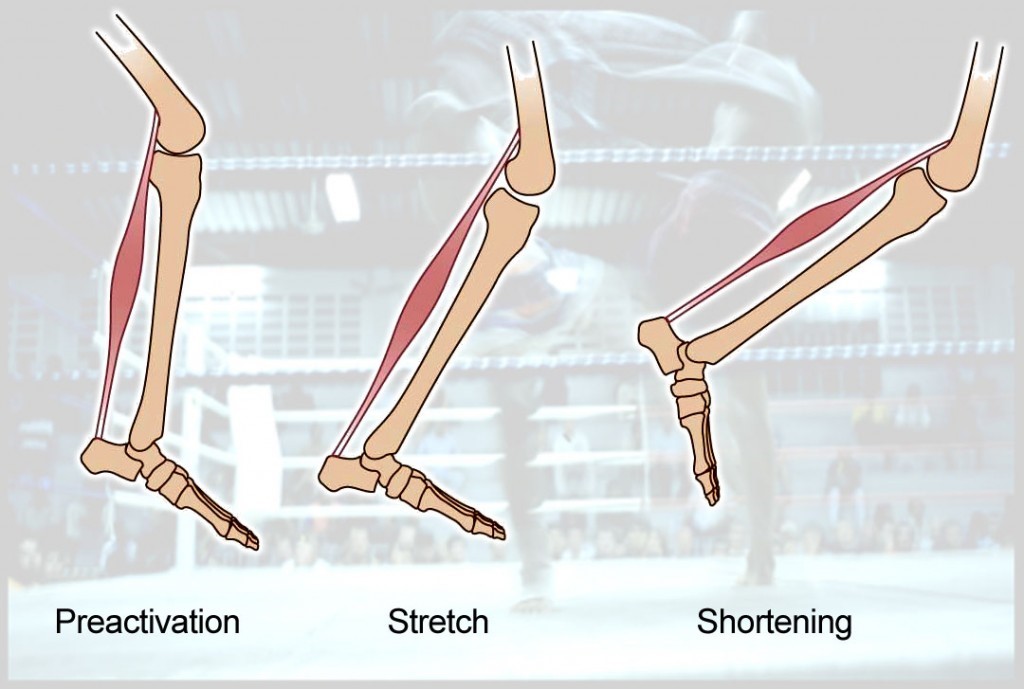
The Stretch Shortening Cycle (SSC) is the body’s natural way to stretch, and so store energy. The benefit of this cycle comes by using it, in addition to your body’s own muscular strength. So, the more muscle, the bigger the stretch and the more elastic energy that can be stored.

Let’s take a look at how this works…

source: Google Images


The stretch shortening cycle involves two phases of muscular contraction

1.Eccentric phase – muscle lengthening under tension
2.Concentric phase – muscle shortening

The pre-stretch of the muscle causes it to be eccentrically lengthened. With this, tension is built in the muscle – similar to a rubber band when stretched. The longer the time the pre-stretch is held, the less tension is stored in the muscle. The shorter period of time for the pre-stretch, the larger the amount of tension.

This stored energy helps increase the strength of the following contraction.

The faster the muscle is stretched eccentrically, the greater the force will be on the following concentric contraction. For example, a quick pliĆ© into a Pas de Chat creates the tension necessary to create height off the floor.

Have a go yourself –

1. Take a rubber band or hairband and hold the band stretched for 5 seconds then release. Notice the small distance the band has travelled. Now, in one movement take the second band, pull back and release. You will note that this band travels a lot further. This is because the second band has not lost tension in the period it is held in, therefore it has a larger amount of tension.
2. The same principle applies when looking at a squat jump (SJ) in comparison to a countermovement jump (CMJ). Sit in a Squat jump and hold this squat position for 5 seconds. After 5 seconds, release and jump.

Next, perform a quick countermovement jump. You will notice
that when you performed a CMJ your jump height was greater.


I hope this brief article helps you to understand how the stretch shortening cycle works and how this can be applied to plyometric training which I shall look at in more detail in a future post.


-E
SHARE:
© Performance Sports Therapy. All rights reserved.
Blogger Templates by pipdig