Thursday, 8 September 2016

All you need to know about muscle cramps


What?
Muscle cramp is the sudden and involuntary painful contraction of muscle (or part of it), which disappears within seconds or minutes and is often accompanied by knotting of the muscle during touch.
Cramp is the repetitive firing of motor unit action potentials, also known as “cramp discharge”.
The cause of cramping is unknown, however it is traditionally believed to be associated with exercise in hot and humid climates i.e. Dehydration and the depletion of electrolytes. However this isn’t fully backed by scientific evidence. Another theory suggests there is a neuromuscular cause. This thought proposes that the muscular overload and neuromuscular fatigue causes an imbalance between the excitatory impulses from muscle spindles and inhibitory impulses from Golgi Tendon organs. However, due to muscle cramping occurring within a variety of situations and environments conditions, some believe it is unlikely that there is a single cause.

Cramp vs. Spasm
It is possible to distinguish cramp from spasms. A spasm is an involuntary and abnormal muscle contraction, however cramps are severely painful (and can result in continued soreness), carry an involuntary and explosive onset with a gradual termination of the muscle stretching. This involves only one/one part of the muscle and it is possible to experience fair and forceful contractions. In addition, muscle cramps tend to occur within the muscles of the calf and foot which can in turn impair athletic performance.  

Who?
Cramps can occur in individuals with motor neuron disorders and metabolic disorders, but can also occur within healthy individuals during sleep, pregnancy and physical exertion.
Some of the reported risk factors for exercise-associated cramps include-
  • Inadequate conditioning for the activity
  • Increased exercise intensity and duration
  • Previous history of cramps during or after exercise
  • Family history of cramping.


Treatment
  • Moderate static stretching 
  • Prevention and treatment methods include fluid and electrolyte balance strategies. The National Athletic Trainers’ Association recommends that athletes prone to muscle cramps add 0.3 to 0.7g/L of salt to their drinks as a preventative tool. Others recommend adding sodium (3.0 to 6.0 g/L) to sports drinks based on the frequency of muscle cramps.Note: fluids and electrolytes are not immediately absorbed. Around 13 minutes is required to be absorbed into the circulatory system.


Prevention
  • Neuromuscular training – there is strong support that the level of conditioning is a factor for the development of muscular cramping and that targeting the neuromuscular system can prevent this. The idea is to prevent neuromuscular fatigue. This could be done through plyometric and endurance training.
  • Ingestion of water or a hypotonic sports drink an hour prior to competition ensures absorption.
  • Maintaining hydration and adequate electrolytes aid in the prevention. Thus, fluids should be readily available throughout practices and competitions.
  • A balanced diet is important to ensure fluid and electrolyte replacement.  


References
Minetto, M.A., Holobar, A., Botter, A. and Farina, D., 2013. Origin and development of muscle cramps. Exercise and sport sciences reviews, 41(1), pp.3-10.
Braulick, K.W., Miller, K.C., Albrecht, J.M., Tucker, J.M. and Deal, J.E., 2013. Significant and serious dehydration does not affect skeletal muscle cramp threshold frequency. British journal of sports medicine, 47(11), pp.710-714.
Miller, K. C., Stone, M. S., Huxel, K. C., & Edwards, J. E. (2010). Exercise-Associated Muscle Cramps: Causes, Treatment, and Prevention. Sports Health, 2(4), 279–283. http://doi.org/10.1177/1941738109357299

SHARE:

Saturday, 27 February 2016

My 5 Top Tips to keeping fit and healthy without all the gadgets


With social media showing you all the latest hot gadgets to use in your daily life and work out, it is easy to forget that you can actually stay healthy and improve performance without these gismos. So, how do we do this? Well I’m going to share my top 5 tips with you.

1. Body weight exercises – plyos, planks and pushups – Build muscle and burn fat through simple body weight exercises which can be performed in your home, local Park or back garden. These efficient exercises are ace because they’re absolutely free and can help to prevent injury, as well as enhancing performance. There are numerous ways to target the body with no equipment such as single leg squats, various plank positions, press ups and single leg balance holds. Plyometric training may also be used to increase power output, a combination of speed and strength which are beneficial within all aspects of training.

2. The essentials – hydration, sleep, chill time and veg – you don’t need these high-tech sleep trackers or fancy water bottles, just get yourself a pint sized glass and a watch. And don’t forget to allow yourself some you time in your busy schedules. I actually spend my chill time in the gym, sleeping or reading a book whilst my boyfriend plays on his Xbox. Yes I don’t have my own chill time quite sorted yet, but I’m working on it! If I’m not doing some kind of work I feel quite guilty. Lastly, don’t forget to eat your veggies! We are all quite aware of boosting our protein and carbohydrate intake for muscle recovery but we tend to forget we should be eating our veggies for essential vitamins. Yes, you can get these through supplement tablets, but why do that when you can get pure goodness from tasty filling veg.

3. Mobility and stretching – why is this important you may ask? Well, by increasing the range of movement at the joints and increasing the extensibility of muscles you reduce the risk of injury when training. This type of training should be built into your weekly training program. I have one session a week which focuses purely on mobility, however throughout the rest of the week I continue to use varied stretching techniques to stay limber. Why not try yours when watching TV in the evening?

4. Yoga and Pilates – Take a look at an online yogi such as Yoga with Adriene who shares her knowledge with you to guide you through different challenges. Or grab a book such as Pilates for Life by Darcy Bussell, which is where I first started my Pilates training.

5. Be experimental – if you have a length of floor in your living room that is sufficient room to carry out your body weight exercises, stretching or mobility session. You might manage to get the rest of your house joining in the fun! Plus, by doing exercises at home, you can easily blast out some good tunes!


HAVE LESS DO MORE

Here I am in my local park working out 


-E
SHARE:

Wednesday, 13 January 2016

The Stretch Shortening Cycle


In a previous post ‘Jump Height and the Dancer’ (http://performance-sports-therapy.blogspot.co.uk/2015/10/jump-height-and-dancer.html) I wrote about the use of plyometric training to enhance performance, prevent injury and rehabilitate athletes. Following on from this post, I am going to give you a little background information into the physiology behind it all.

I’m not one for writing massively long posts, and I know dancers aren’t one for reading them either. So here is a quick read on the stretch shortening cycle, what it is, and how it works.


source: Pinterest


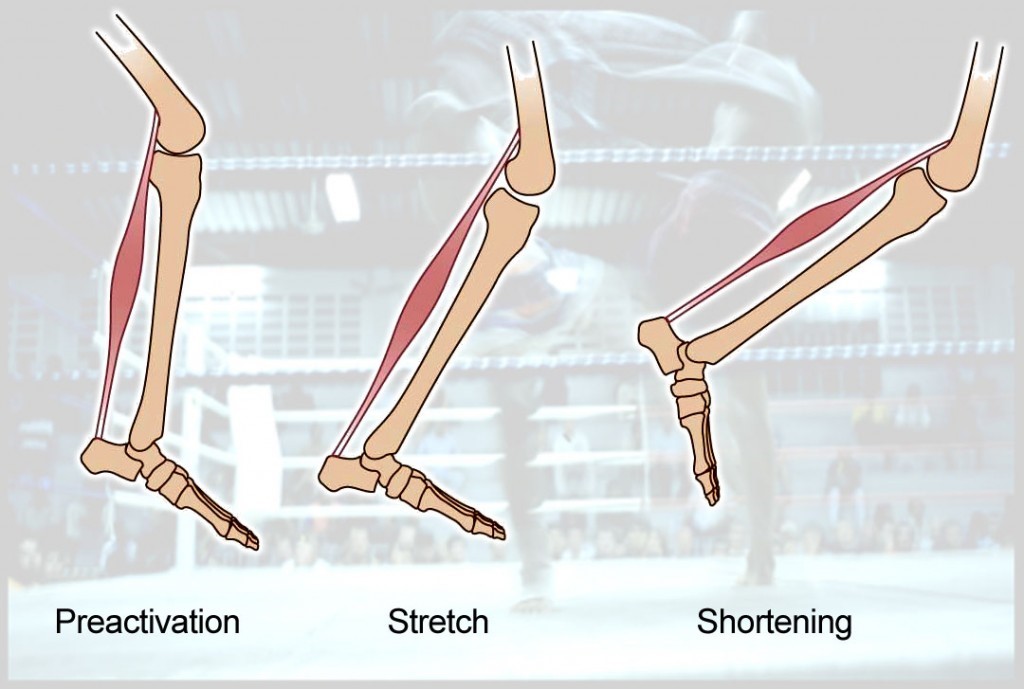
The Stretch Shortening Cycle (SSC) is the body’s natural way to stretch, and so store energy. The benefit of this cycle comes by using it, in addition to your body’s own muscular strength. So, the more muscle, the bigger the stretch and the more elastic energy that can be stored.

Let’s take a look at how this works…

source: Google Images


The stretch shortening cycle involves two phases of muscular contraction

1.Eccentric phase – muscle lengthening under tension
2.Concentric phase – muscle shortening

The pre-stretch of the muscle causes it to be eccentrically lengthened. With this, tension is built in the muscle – similar to a rubber band when stretched. The longer the time the pre-stretch is held, the less tension is stored in the muscle. The shorter period of time for the pre-stretch, the larger the amount of tension.

This stored energy helps increase the strength of the following contraction.

The faster the muscle is stretched eccentrically, the greater the force will be on the following concentric contraction. For example, a quick pliĆ© into a Pas de Chat creates the tension necessary to create height off the floor.

Have a go yourself –

1. Take a rubber band or hairband and hold the band stretched for 5 seconds then release. Notice the small distance the band has travelled. Now, in one movement take the second band, pull back and release. You will note that this band travels a lot further. This is because the second band has not lost tension in the period it is held in, therefore it has a larger amount of tension.
2. The same principle applies when looking at a squat jump (SJ) in comparison to a countermovement jump (CMJ). Sit in a Squat jump and hold this squat position for 5 seconds. After 5 seconds, release and jump.

Next, perform a quick countermovement jump. You will notice
that when you performed a CMJ your jump height was greater.


I hope this brief article helps you to understand how the stretch shortening cycle works and how this can be applied to plyometric training which I shall look at in more detail in a future post.


-E
SHARE:
© Performance Sports Therapy. All rights reserved.
Blogger Templates by pipdig